Before the Tracker: Counting Movement by Hand
Counting movement by hand helps you notice where activity fits, choose a useful record and keep a simple habit without relying on a device.
Should you count your movement by hand, and what should you count? Counting movement by hand can be as simple as making a mark after a walk, a set of stretches or a dance break. The useful part is not building a perfect record; it is deciding what you want to notice, then choosing a tally that is easy to keep.
A paper log will not automatically make you more active. It can, however, turn a vague impression—“I hardly moved today”—into a clearer account of what happened and when. The right format depends on your reason for keeping it. A person trying to remember short activity breaks needs a different record from someone who wants to see how often they take a regular walk.
Choose a record that answers your real question
Before reaching for a notebook, finish this sentence: “I want to notice…” The answer guides what deserves a mark. If you want to see whether movement finds its way into a busy day, record occasions. If you want to protect a routine, record whether the routine happened. If you are curious about variety, record the kind of movement rather than the amount of time spent doing it.
Keep the first version narrow. A line for every movement, minute and mood can turn an ordinary habit into paperwork. Pick one question and a short period in which to observe it. You can change the record later if it stops answering that question.
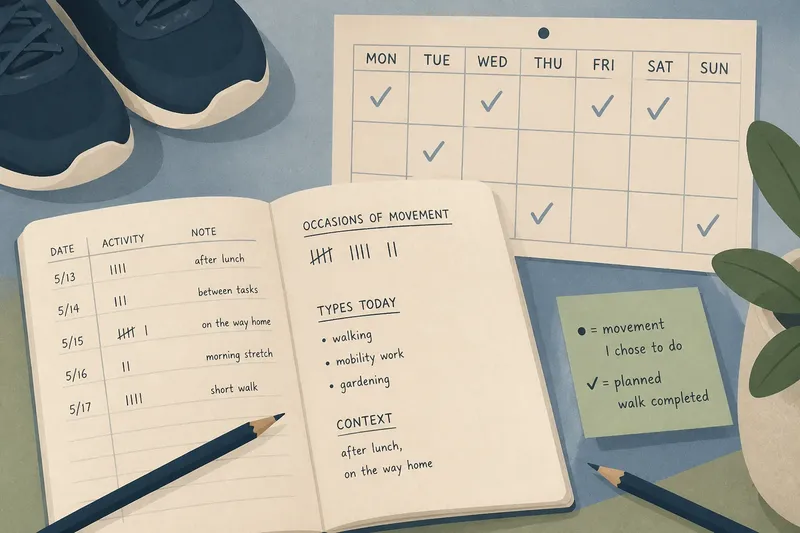
- To notice frequency: make one mark for each separate occasion of movement.
- To notice a routine: use a simple day-by-day box for the activity you intend to practise.
- To notice variety: jot down a plain word such as walking, gardening, dancing or mobility work.
- To remember context: add a brief note about where or when movement fitted, such as “after lunch” or “on the way home”.
These are different records, not competing measures. A tally of occasions cannot tell you how long you moved, and a list of activity types does not describe effort. That is fine if those details are not what you need.
Match the tally to the shape of your day
If your activity tends to happen in one planned block, a daily mark may be enough. Draw a row of boxes for the days you want to track and tick a box when that activity takes place. This suits someone who wants to remember whether a walk or a class is part of the week, without turning each outing into a report.
If movement appears in small pieces, use one mark per occasion instead. A few minutes of walking to a shop, a stretch between tasks and a later stroll can each earn a mark if your question is about how often you move. Decide what counts as a separate occasion before you begin. For example, you might treat one uninterrupted walk as one occasion, even if you pause at a crossing.
If you are rebuilding a routine after a disruption, use a record that recognises the activity you can actually do now. A short walk can count as a walk; gentle mobility work can count as mobility work. Avoid setting the tally up so that only an ideal session qualifies. The record is there to describe your practice, not grade it.
If you share activity with someone else, keep separate marks unless you have a shared question. A household tally may help you remember that you take a walk together, but it cannot show each person’s own pattern. A small notebook kept by the door can be easier to use than a chart that requires everyone to recall the day later.
Use a method you can mark in the moment
For occasional movement, a pocket notebook and pencil are enough. Draw a few columns for the date, activity and optional note. Write only what you are likely to use. If you mainly want to count occasions, a row of tally strokes beside each date is quicker than a description of every activity.
A wall calendar works well when the question is whether a regular activity happened on particular days. Put a small symbol in the date square, and use a key if you track more than one kind of movement. A loose sheet on the fridge or near your walking shoes can suit an informal habit, provided it stays somewhere you will see it.
For activity that happens away from home, carry a folded card or make a note as soon as you return. Trying to reconstruct a day from memory can blur separate occasions together. If you do not want to carry paper, use a repeated mark on a sticky note or a note in a notebook you already take with you; the point is a dependable place to record, not a particular tool.
Choose one symbol and define it in plain language. A dot might mean “movement I chose to do”, while a tick might mean “planned walk completed”. Do not make one symbol stand for several different things unless you can still read it later.
Read the record as a prompt, not a verdict
At the end of the period you chose, look for a pattern that can guide one decision. Are there days when movement naturally fits? Does a walk happen more readily when you connect it to an errand? Are short breaks easier to remember than a single planned session? These are observations about your circumstances, not scores on your character.
Say you want to see whether a short walk can fit into a workday. You draw one small box for each weekday and tick it only when you take a walk away from your desk. After several ordinary workdays, you notice the ticks gather on days when you leave your walking shoes by the door; you might keep that cue and see whether it remains helpful. This invented situation illustrates a modest use for a log: it makes a detail visible so you can choose what to try next.
Look at missing marks with curiosity rather than trying to fill them in after the fact. Perhaps you forgot to record an activity, or perhaps the activity did not happen. If you cannot tell which, the record is showing that its method needs to be easier or its question needs to be narrower. A missed mark is not an instruction to make up a number.
What is not worth the effort is logging every incidental movement when you only want to know whether you have a regular walking habit. That level of detail adds work without improving the decision. Keep the notes that help you see a pattern; leave the rest out.
Which hand-counting method fits your situation?
What should I count if I want to move more often?
Count separate occasions, using one mark each time you intentionally get up and move. This shows frequency without pretending to measure duration or effort.
What should I record for a planned weekly activity?
Use a simple calendar or day-by-day grid and mark whether the activity happened. This is a good fit when you want to remember the shape of a routine rather than catalogue every movement.
Can I count household tasks or travel on foot?
Yes, if those activities belong to the question you chose. Decide in advance whether, for instance, walking to the bus stop counts, then apply that rule consistently enough for the record to be readable.
What if I miss a day or forget to write something down?
Leave the blank rather than guessing. If forgetting happens often, move the log closer to the activity or make the mark simpler, such as a single tick instead of a written account.
Keep the habit small enough to continue
Give the record a clear home: beside your calendar, near the shoes you use for walks or in a notebook you already open regularly. Attach marking to an existing moment, such as returning from a walk or making a cup of tea. A record that depends on remembering a separate task is easy to abandon.
Review it occasionally, but do not turn review into a second tracking project. Ask whether the log helped you notice something or make a choice. If it did, keep the useful part. If it became a chore, simplify the categories, shorten the period or stop recording. You do not owe a notebook an unbroken run.
Hand-counting movement is most useful when the record stays honest about what it captures. Choose occasions, planned sessions or activity types according to your question, and use a mark you can understand later. Counting movement by hand can then offer a quiet prompt: not a device-free version of every possible metric, but a small record that helps you pay attention to the activity already present in your day.