A Hip Hinge Helps You Reach a Low Shelf
A hip hinge helps you reach a low shelf by sharing the movement across your hips and knees, so you can adjust the reach to the task.
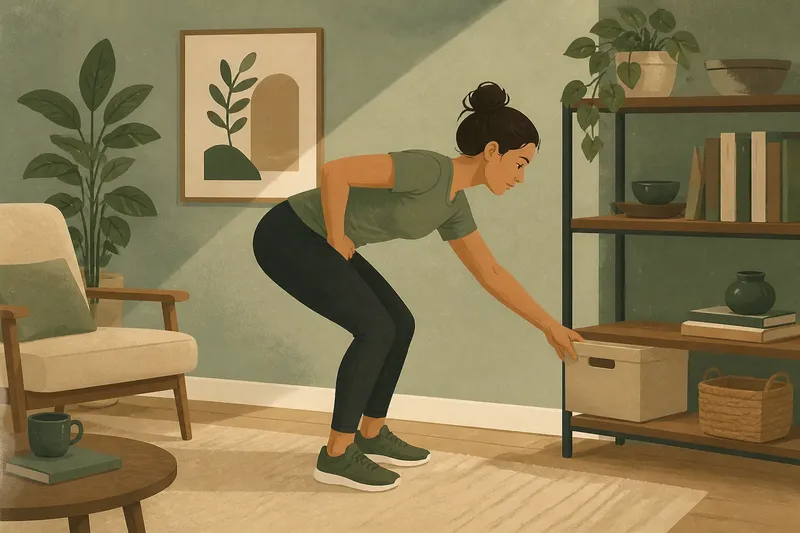
How can you reach towards a low shelf without simply folding at the waist? A hip hinge helps you reach a low shelf by sending your hips back as your torso inclines. Your knees soften, and your feet stay grounded. It is a useful movement pattern to recognise in ordinary reaching, not just in a gym exercise.
A hip hinge starts with the hips moving back
In a hip hinge, the pelvis rotates around the tops of the thigh bones. Your hips travel backwards, your knees bend a little, and your trunk tips forward. Your spine does not need to be rigid; it generally keeps its natural shape rather than rounding sharply to create all the reach.
A forward fold may involve more movement through the spine and less travel at the hips. Neither pattern is automatically wrong: reaching down to tie a shoe is not a technical examination. The distinction is useful when you want to share the movement among your hips, knees and trunk instead of asking one area to do nearly everything.
To notice the hip movement, stand comfortably and place your hands on the creases at the front of your hips. Send your backside gently behind you. As your torso leans, those creases deepen. This gives you a physical reference without requiring you to hold your back completely straight.
Adjust your stance and reach for a low shelf
Imagine a light box on a low shelf, close enough to reach without stretching. Soften your knees, move your hips back and incline your trunk towards the box. Keep your feet planted and let your hands arrive without dropping your shoulders suddenly. You should be able to observe your hips and knees taking part in the reach, rather than seeing only a bend in your middle.
For a very low shelf, a hinge alone may not be comfortable. Bending your knees further can make the movement more like a squat; stepping closer or turning slightly may also help. The useful skill is recognising which joints are moving, not forcing every low reach into one textbook shape.
Distance changes the task. If the shelf is far away, you need to reach further with your arms and lean your trunk more, which may make your balance feel less settled. If there is room, bring your feet nearer and keep the object close as you lift it. A smaller reach is often easier to control.
Check your feet, knees and balance
- Observe whether your feet stay planted; if your toes lift or your weight shifts towards an edge, then make the hip movement smaller, or step closer to the shelf.
- Observe whether you feel steady over your feet; if you feel you might fall backwards, then reduce the reach, or use a more knee-bent squat-like approach.
- Observe whether your knees feel comfortable and point in the same general direction as your toes; if they feel strained or collapse inwards, then use a shallower hinge, or adjust your stance.
- Observe whether your knees are softly bent; if they are locked and the reach feels awkward, then unlock them, or bend them further if that feels more comfortable.
- Observe whether your shoulders reach forward to compensate for a distant object; if they do, then move closer, or turn towards the shelf if the space makes that easier.
- Observe whether the object stays close to your body as you lift; if it moves away, then bring it nearer, or choose a lighter object that you can manage comfortably.
A wall can provide a simple cue. Stand with your back a short distance in front of it and try to touch it with your hips by sending them backwards. Keep your feet grounded and move closer to the wall if you have to reach or lose balance. Treat the wall as a target, not a reason to push hard or arch your back.
Let your trunk move without freezing it
“Keep your back straight” can be confusing if it leads you to brace every muscle or hold your breath. Instead, let your head, ribs and pelvis move together as your trunk inclines. Your spine can retain its natural curves while your hips provide much of the motion.
As you hinge, let your head follow the angle of your trunk rather than craning your neck to look straight ahead. Your eyes can still track a low object; a fixed head position need not override a comfortable neck.
Breathing should remain ordinary during an unweighted reach. If you grip tightly or hold your breath, make the movement smaller and slower. That is a cue to reduce the effort, not a verdict on your technique.
Practise with an everyday object
Choose a light object, such as a folded tea towel, and place it on a low chair. Stand close, soften your knees, send your hips back and reach for it. Return to standing by bringing your hips forward without snapping them into place. Continue only while the movement feels smooth and comfortable.
Say you want to reach a folded tea towel on a chair, and your lower back rounds as soon as your fingers approach it. First, move your feet closer to the chair and try a shallower hinge. If you still need to round to reach, place the towel on a higher surface and try again. The resulting choice is clear: use the version that lets you reach without straining, even if it means changing the object’s position or bending your knees more.
It is not worth repeating a hinge until every repetition looks identical, or chasing a dramatic hip movement for a household reach. The movement should serve the task. If a small reach is all you need, a small hinge is enough.
What do people ask about a hip hinge?
Is a hip hinge the same as a deadlift?
A deadlift is an exercise that often uses a hip-hinge pattern while lifting an object from a low position. The hinge itself is a movement pattern, and it can appear in everyday actions without a barbell or formal workout.
Should my knees stay straight during a hip hinge?
No. A small, comfortable bend usually gives your hips room to move back. Locked knees can make a reach awkward, while bending them deeply may shift the action towards a squat.
How low should I hinge?
Go only as low as the task requires and your balance and comfort allow. The object’s height, your stance and the available space all affect the reach.
What if a hip hinge feels uncomfortable?
Stop that version and choose an easier reach, such as using a higher surface or bending your knees more. For persistent pain, a new injury or concern about movement, seek guidance from a qualified health professional.
Use the hip hinge for different everyday reaches
You may recognise a hip hinge when reaching for a bag near the floor, leaning towards a low drawer or tending to a plant. Each task has its own demands, so the movement may blend with a squat, a step or a turn. Your hips can travel back as your trunk inclines, giving you an option besides folding through the waist.
For your next low reach, notice just one thing: where your hips move in relation to your feet. That observation can help you adjust the hip hinge to the shelf, object and space in front of you.